Ask any seasoned line cook or executive chef which single tool defines their efficiency in the kitchen, and they will point to an 8-inch chef’s knife. Yet for countless home cooks, prepping vegetables remains the slowest, most exhausting part of cooking dinner. Slippery onions wobble across plastic cutting boards, herbs end up crushed and bruised rather than cleanly sliced, and fingers stay dangerously close to sharp edges. Mastering basic culinary knife mechanics transforms cooking from an intimidating chore into a fluid, rhythmic, and safe daily ritual.

The Foundation: Blade Anatomy and Board Stabilization
Before cutting a single vegetable, culinary schools teach two fundamental setup rules that prevent 90% of household accidents:
- The Damp Towel Anchor: A cutting board that slips across a smooth kitchen counter is an accident waiting to happen. Always dampen a thin paper towel or dishcloth and place it directly beneath your wooden board. Press down firmly; the board should not budge under pressure.
- Choosing the Right Board Material: Hardwood edge-grain or end-grain cutting boards (like maple, walnut, or acacia) absorb blade impact and keep your steel sharp. Glass, marble, and ceramic boards dull knife edges within minutes and should never be used for chopping.
- Understanding Blade Balance: A standard Western or Japanese gyuto knife is designed with a pivot center right where the blade enters the handle (the bolster). Holding the tool at this balance point gives you full leverage without fatiguing your wrist.
How to Hold a Chef’s Knife: The Pinch Grip
Most home cooks grasp the handle like a hammer or extend their index finger straight along the top spine of the blade. Both habits reduce control and force your wrist into strained, jerky motions.
The correct technique used across commercial kitchens is the Pinch Grip:
- Pinch the base of the blade right where the steel meets the handle between your thumb and the side of your bent index finger.
- Wrap your remaining three fingers (middle, ring, and pinky) comfortably around the handle itself.
- Lock your wrist in a neutral line. The knife now becomes an extension of your forearm, allowing the weight of the steel to do the cutting rather than downward muscle pressure.
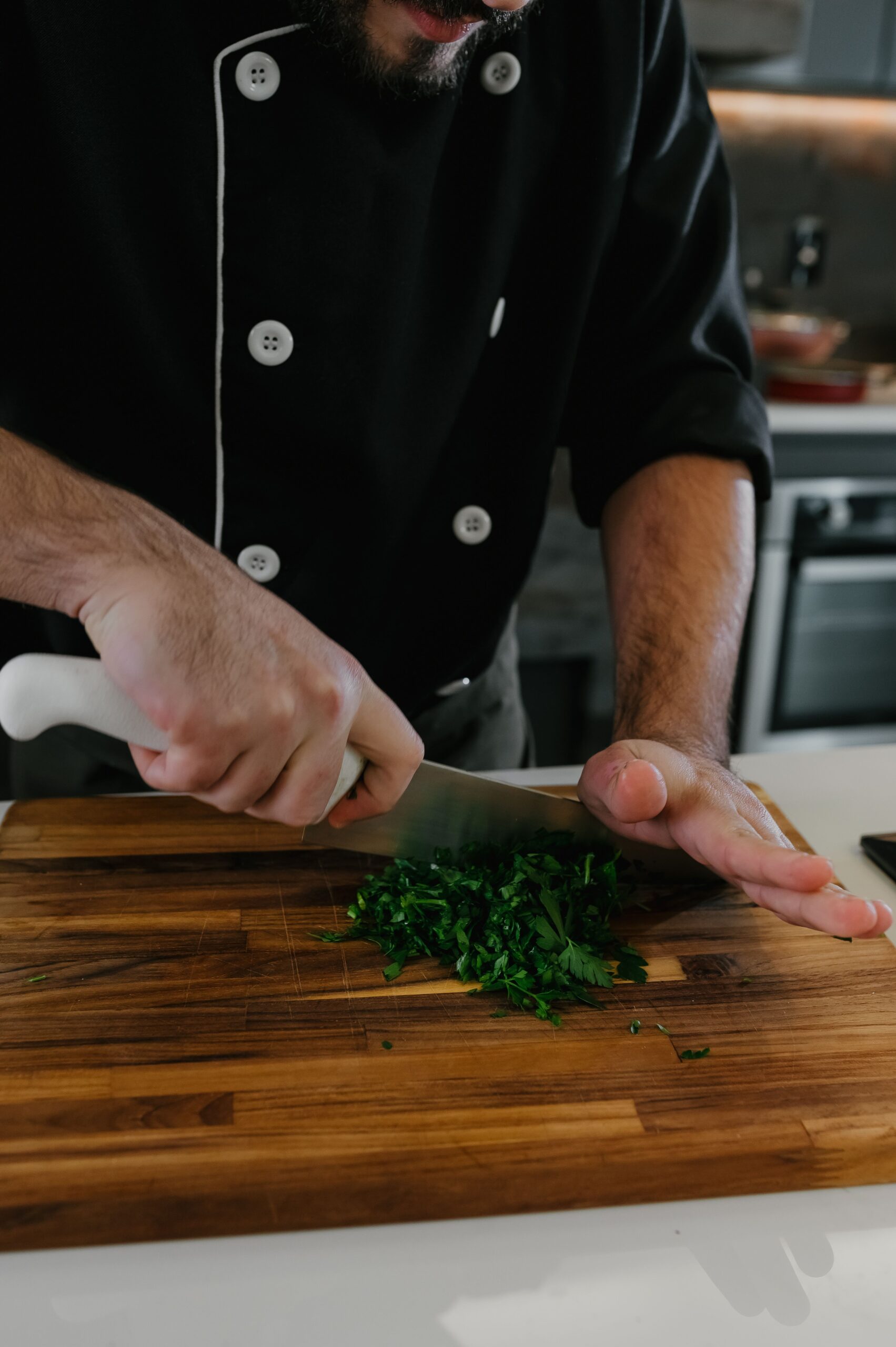
Guiding the Blade: The Protective Claw Technique
Your non-knife hand is responsible for holding the vegetable in place and guiding cut thickness. Leaving fingertips exposed or flat against the food is the most common cause of painful kitchen cuts.
- Curl Your Fingertips: Curl your fingers inward like you are clutching a small ball, tucking your fingernails completely beneath your knuckles.
- Rest the Flat of the Blade: Rest the broad side of your knife blade gently against the middle flat of your guiding knuckles. The blade edge remains lower than the knuckle joint, making it physically impossible for the knife to catch your fingertips.
- Walk Backwards: As you slice through carrots, cucumbers, or celery, inch your claw hand slowly backward along the food. Keep thumb tucked behind the fingers at all times.
Core Chopping Motions: Slice, Glide, and Rock
| Technique | Motion Mechanic | Best Suited For |
|---|---|---|
| The Rock Chop | Keep blade tip on the board; roll the curved belly up and down smoothly | Leafy herbs, garlic cloves, flat greens, and coarse mincing |
| The Forward Push-Cut | Push the knife forward and downward simultaneously through the vegetable | Firm root vegetables, carrots, potatoes, hard winter squashes |
| The Draw Cut (Pull-Cut) | Draw the sharp heel toward the tip in a light, single backward glide | Tender tomatoes, soft stone fruit, raw meat cuts, delicate citrus |

Why Cut Uniformity Matters in Everyday Cooking
Uniform cuts are not just about culinary aesthetics—they directly impact cooking chemistry. When vegetables in a pan vary wildly in size, tiny fragments turn to bitter mush before thicker chunks even soften. Uniformly diced mirepoix (onions, carrots, and celery) browns evenly, releases moisture at identical rates, and forms the balanced flavor base of rich sauces and braises.
Essential Maintenance: Honing vs. Sharpening
Many home cooks mistakenly believe a dull knife is safer than a sharp one. In reality, a dull blade requires heavy downward force, slips off smooth vegetable skins (like bell peppers and tomatoes), and easily cuts hands. Maintaining your edge requires two distinct tools:
- The Honing Steel (Weekly Alignment): A long metal or ceramic rod does not remove steel. Instead, it straightens the microscopic teeth of the blade edge that curl during cutting. Glide the blade down the rod at a 15-to-20 degree angle 4 to 5 times per side before major prep sessions.
- Whetstone or Professional Sharpening (Twice Yearly): When a honed knife still squashes rather than cleanly slices through a ripe tomato skin, the edge has lost metal and must be ground on a sharpening stone to restore bevel geometry.
- Washing Discipline: Never put fine kitchen knives in the dishwasher. High-pressure water knocks blades into racks, dulling the edge, while intense alkaline detergents corrode high-carbon steel and swell wooden handles. Hand-wash with warm water, wipe dry immediately, and store safely on a magnetic wall strip or wooden block.
Frequently Asked Questions
What is the best all-around knife size for a beginner?
An 8-inch chef’s knife or a 7-inch Santoku is the sweet spot. It offers enough length to halve large cabbages or squash, while remaining nimble enough for fine garlic mincing.
How should I scrape cut vegetables off my wooden board?
Never scrape ingredients with the sharp cutting edge of your knife; this curls and blunts the blade in seconds. Always flip the knife and use the flat spine, or use a stainless steel bench scraper.
How can I stop crying while chopping onions?
Keep your knife razor-sharp. A sharp blade cleanly slices onion cells without crushing them, releasing significantly fewer aerosolized syn-propanethial-S-oxide compounds into the air.